Notes to Leaders
Servant Leadership
(Please be sure and see my two invitations at the bottom of this post.)
Serve Up Some Good Leadership Today!
I fired a CEO once.
After just a few weeks of working with him, I knew I couldn't help him. The moment came when I realized the two of us had a fundamentally opposite view of leadership.
From his perspective, everyone around him was there to serve him and make him look good. He was the smartest guy in the room. He treated the perks of his position as entitlements. And he didn't really listen. When problems surfaced, they were the fault of others – and all he wanted was coaching for how to fix those people.
He saw his role as the center of the organization. I saw it as being in service to the organization. Until he removed the “self-serving” lens through which he viewed leadership, no amount of coaching was going to bridge the gap – the gap from self-centered to other-centered.
Two Kinds of Leaders
In 1970, Robert Greenleaf wrote an essay that reshaped how many of us think about leadership. In "The Servant as Leader," he drew a sharp distinction:
"The servant-leader is servant first - it begins with the natural feeling that one wants to serve, to serve first. Then conscious choice brings one to aspire to lead. This contrasts sharply with one who is leader first, perhaps because of the need to assuage an unusual power drive or to acquire material possessions."
The order matters. And the difference shows up everywhere:
You are here to serve me vs. I am here to serve you
It's all about me vs. It's about you
It belongs to me vs. It is here for others
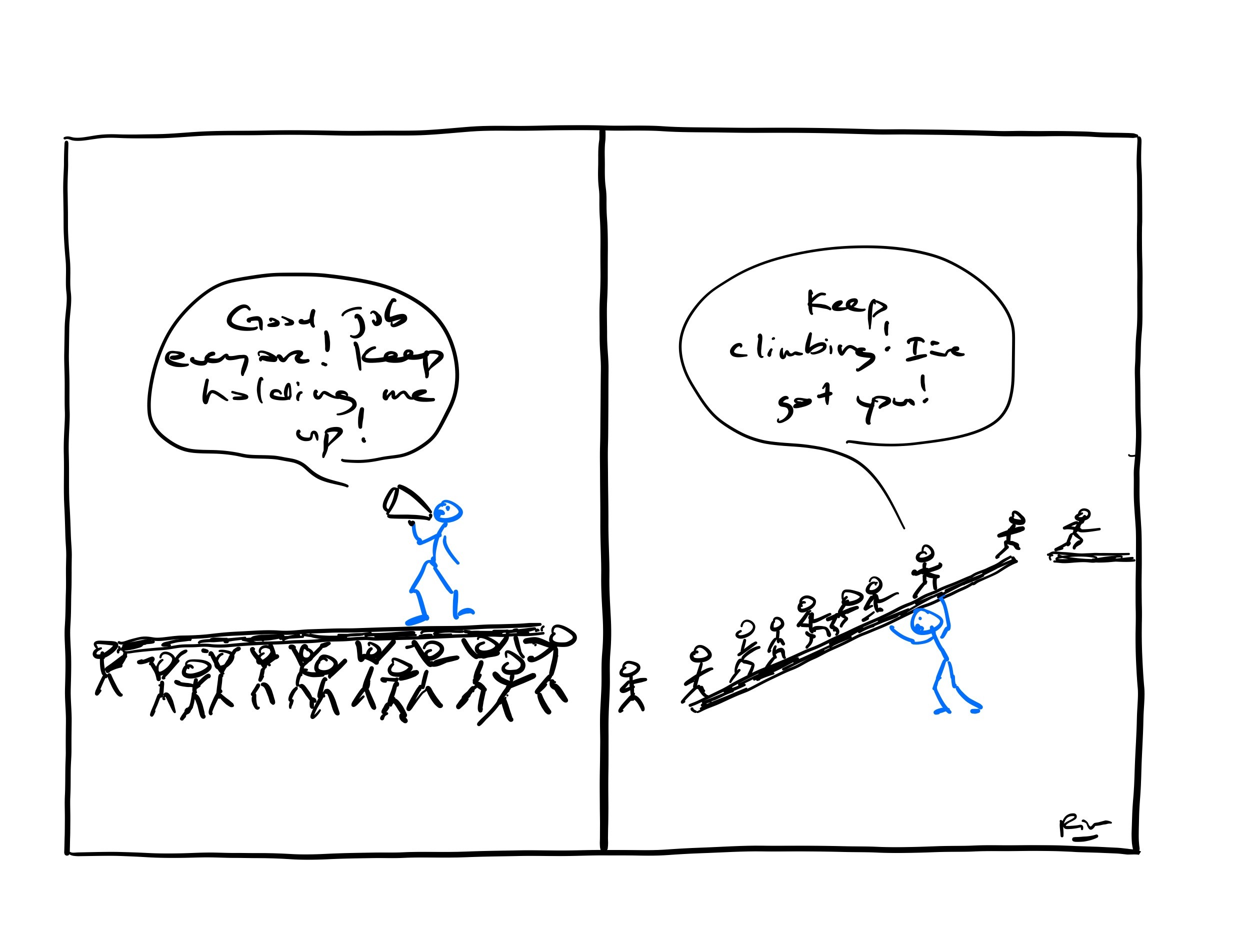
When you are leader first, people become tools for your success. But when you're servant first, leadership becomes a platform for helping others succeed.
I have come to realize I take servant leadership for granted now. It's so deeply wired into how I think about leadership that I sometimes forget it's not everyone's default. And it's not a set of tactics you can fake. It is a mindset.
What Servant Leadership Looks Like
Simon Sinek's book "Leaders Eat Last" captures this mindset perfectly. The title comes from the military tradition where officers eat last, after their troops have been fed. It's a simple act that signals everything about leadership priorities.
Servant leadership manifests in many different ways (Greenleaf identified at least ten characteristics). Here are my big three:
Stewardship: I am entrusted to protect and grow something that belongs to or exists for the sake of others. In the words of Bob Dylan, we’ve all “gotta serve somebody!" I'm not building my empire. I'm a steward of people, resources, and a mission bigger than me.
Grow Others: A measure of my success isn't how much I accomplish, but how much “we” accomplish and how well I develop the leaders under me. If I leave and everything falls apart, I didn't really lead. I just controlled.
Serve Others: I'm constantly looking for how I can help those under my leadership do their jobs better. That means supporting them, removing barriers, and making sure I'm not a barrier myself. Servant leaders get out of the way.
Why It Matters
Servant leadership isn't just noble-sounding theory. It's better leadership. It builds genuine trust and loyalty. It makes for better communication and sharing of information, which leads to better execution. It grows future leaders to support the growth of the organization.
The CEO I fired? He never understood this. He couldn't see past his own reflection to recognize that leadership isn't about personal power or control. And because of that, he couldn't build the kind of organization that thrives.
The beauty of Greenleaf's framework is that it starts with a choice. Servant first, then leader. It's not about your personality type or natural gifts. It's about what you fundamentally believe your leadership is for.
What kind of leader would your reports say you are? Do you serve them? Or are they simply there to serve you?
-----------------
Two invitations:
Feedback! I am working on my “next book.” This will be a tactical “how-to” on leadership, 40+ short chapters with titles like “How to Manage Your Time,” “How to Handle Conflict,” and “How To Do What They Think Can’t Be Done.” I am looking for TEN leaders who would periodically receive advance versions of a chapter and give me simple feedback. Each chapter is only four to five pages long. Sign up here.
Feelings! I recently spoke on emotional blind spots that hold leaders back in a 50-minute podcast with my newest buddy in Atlanta – Skot Waldron. Skot said his “brain exploded” at one point over something I said. Access the podcast here. Watch it here.
Lastly, I always welcome your feedback!