Notes to Leaders
When Everyone Else is Blaming . . .
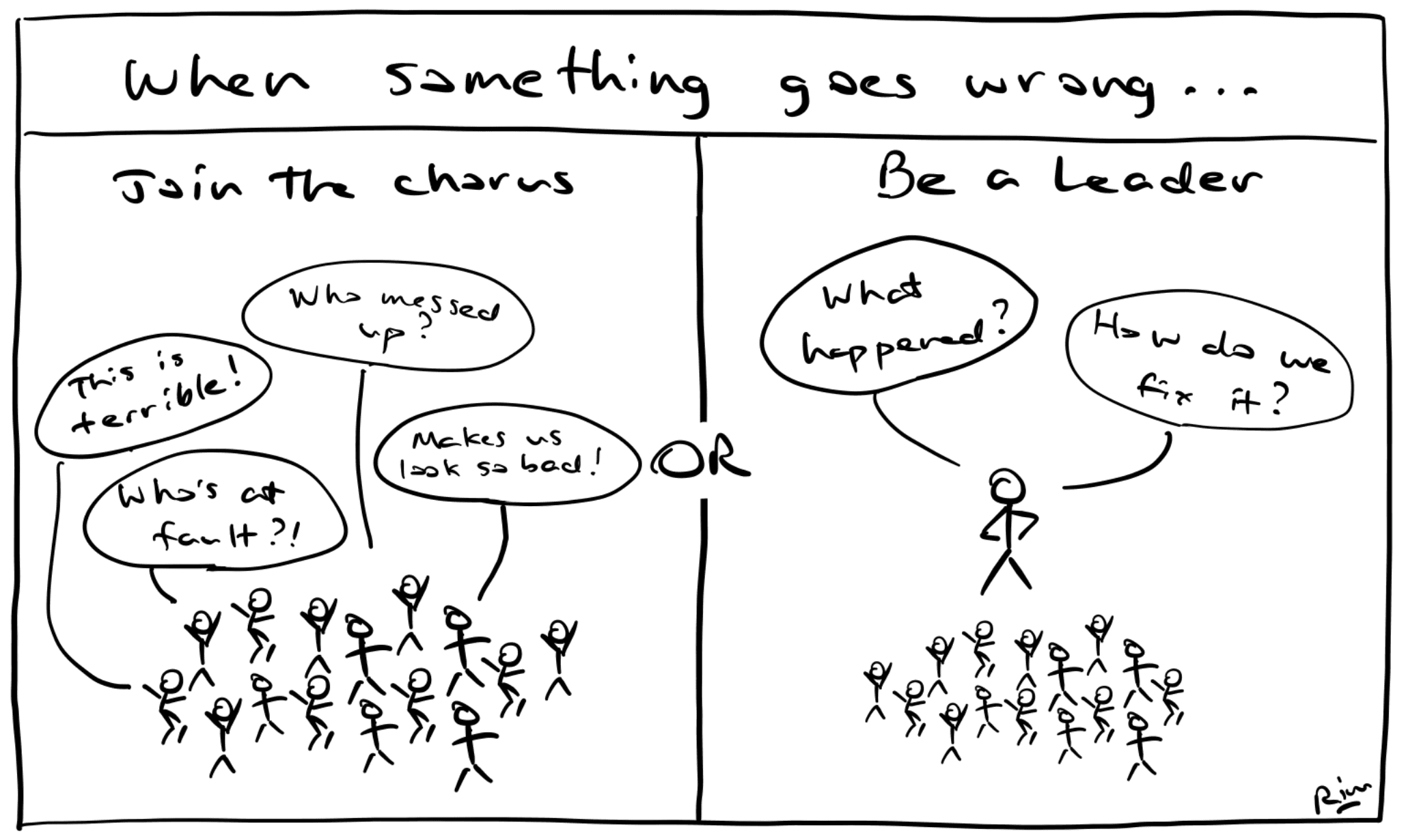
39,000 mistakes. This is what a foundation CEO friend of mine had to navigate recently. An end-of-year fundraising mailer – 39,000 letters -- had just gone out. And there was a mismatch between names used for the address on the envelopes and names used at the top of the letter itself. For instance, the envelope could have been addressed to Bill and Jamie Campbell, but when you opened it up, the letter started with "Dear Mike and Carrie."
Her first awareness of the mistake came from members of her board who had received their letters. Then she heard from members of another board whose organization was the primary recipient of the foundation. “This is terrible!” “This is a disaster!” “It makes us look so inept!” Panic grew. Then the question: "Who is responsible for this fiasco?!"
When is the last time you witnessed people casting blame? How recently have you been the target of blame?
I cannot address this topic without recalling words of my mentor Jerry Leachman: “Losers blame others. Winners take responsibility.” For the purpose of this writing, I would simply substitute “Leaders” in place of “Winners.”
So there’s the choice: when mistakes happen on your watch, do you blame others? Or take responsibility?
It’s easy to blame others.
The instinct to assign blame is both deeply human and increasingly amplified by modern culture. When something goes wrong, uncertainty creates discomfort. Blame offers relief, serves as a shortcut. It gives shape to chaos, names a villain, and restores a sense of order—even if only temporarily. We like to locate a single cause and move on.
Our broader culture tends to be a blaming culture. Social media rewards outrage and mic-drop answers. Complex explanations don’t travel well; clear villains do.
Lastly, blaming someone is a “one-up” ego tactic. (Those of you who have attended one of my workshops may remember I emphasize that leaders “stay level” not “one-up” or “one-down.”) Blaming another protects me. If I say the mistake belongs to you, then I remain competent, smart, and in control. Organizations obsessed with blame produce fear, silence, and risk-avoidance. People stop speaking up, experimenting, and telling the truth—the very behaviors leaders say they want.
So blaming is a loser move.
Leaders are called to be different.
Here are three steps to consider the next time a mistake happens under your leadership.
1. Slow the moment before you respond. The instinct to react quickly is powerful—especially when others are demanding answers. But speed often leads to defensiveness, premature conclusions, or misplaced blame. Pausing creates space for clearer thinking and learning what actually happened, and signals steadiness under pressure. It also prevents leaders from locking themselves into a narrative they may later regret.
2. Take visible ownership without taking inappropriate blame. Leaders must own their role, even when they are not the sole cause. Ownership sounds like: “I’m responsible for the system this occurred in, and we’re going to address it.” This builds trust and credibility.
3. Shift the conversation from “who” to “what and how.” Blame-driven environments fixate on who failed. Learning-driven leaders redirect attention to what failed and how it failed. They examine processes, assumptions, incentives, communication breakdowns, and decision points. This reframing shifts the emotional tone. People become more honest, more reflective, and more engaged in solutions. The leader’s job is to model curiosity instead of defensiveness, and learning instead of punishment.
My CEO friend responded masterfully when confronted with these 39,000 mistakes. Instead of reacting to all the panicky blame noise, she focused her team on getting answers. Where exactly did the breakdown occur? What could they do quickly to mitigate any reputational damage? Her team soon learned that all the mailing data had left their office correct, but got scrambled in the third-party printer’s software.
Once they had clarity on exactly what happened, she developed and communicated a detailed plan of action. By noon the next day, an email was sent to all leadership explaining the situation and the action steps underway. That afternoon, a mass email was sent to all 39,000 constituents stating objectively what had happened, and that a remedy was in process. In it were a phone number and email address straight to the Foundation to talk directly with a live staff person. The overwhelming majority of donors who responded were forgiving and grateful for swift acknowledgement and follow-up. Finally, within three days, the vendor re-mailed the original letter, at their own expense, with their own apology and a note from the Foundation CEO thanking everyone for their understanding.
The next time you find yourself in a blame storm, be a good leader. Leaders take responsibility.